How One Ecosystem Produced Five World-First Innovations in a Matter of Weeks

Updated: Jun 17
During the past two months, something unusual happened inside the Life-X ecosystem.
For years, one criticism followed our work almost everywhere:
“I don’t understand what you actually do.”
To be fair, that criticism was justified.
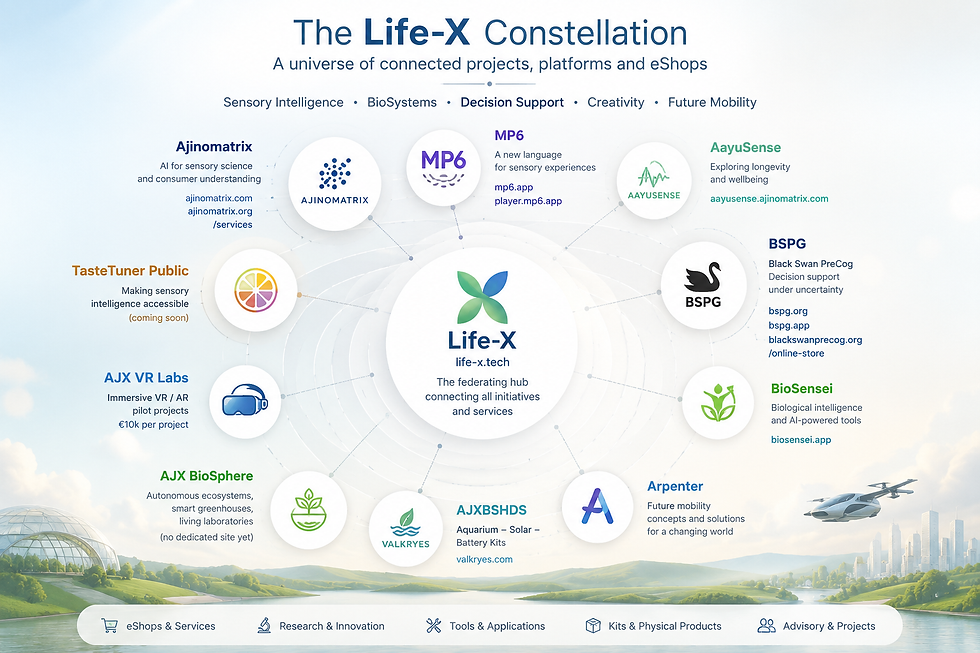
People would hear about Ajinomatrix, then MP6, then BioSensei, then BSPG, then Namasthay, then Lurch Productions. To an outside observer, it could easily look like a collection of unrelated projects moving in different directions.
The reality was almost the opposite.
The projects were connected from the beginning. The problem was that we had never found a simple way to explain the connection.

The Life-X Ecosystem - A first look representation.
Ironically, it took a series of rapid product releases to make the architecture finally visible.
One Release at a Time
The turning point came during a particularly productive period at La Favouille.
Within a matter of weeks, several major initiatives reached demonstrable form.
The MP6 ecosystem continued to evolve with the release of the MP6 Recorder, MP6 Player, validation tools and conversion utilities.

At the same time, BSPG advanced as an experimental framework for pattern recognition, risk anticipation and AI-assisted reasoning.
Meanwhile, BioSensei evolved from a concept into something much more tangible: a real application capable of helping people monitor and understand living ecosystems such as aquariums, paludariums and terrariums.
Individually, these developments looked unrelated.
Together, they revealed something much larger.
The Moment BioSensei Changed Everything
Among all recent developments, BioSensei produced the most interesting reactions.
People who struggled to understand sensory AI immediately understood the idea of an intelligent companion helping them care for fish, turtles, plants and living ecosystems.
The conversations suddenly became simpler.
Instead of explaining data structures, AI models or sensory digitization, we could simply say:
“Imagine an app that helps you understand what is happening in your aquarium.”
Most people understood the value instantly.
That was an important lesson.
The technology itself was never the difficult part.
The difficult part was making its purpose visible.
A Question Inspired by a Child
Recently we started discussing a new test.
Could a young child explain what Life-X does?
Not the technical details.
Not the software architecture.
Just the idea.
If a child can understand the purpose of a project, chances are that journalists, teachers, investors and customers can understand it as well.
If not, the explanation is probably too complicated.
That question has become surprisingly useful.
Every new project now has to survive what we jokingly call the “Elyna Test”:
“Could Elyna explain this to someone else?”
When the answer is no, we simplify.
The Hidden Connection
Once we started looking through that lens, the ecosystem suddenly became easier to describe.
Ajinomatrix helps digitize sensory experience.
MP6 provides a structured format to record and exchange it.
BioSensei applies observation and interpretation to living ecosystems.
BSPG explores higher-level pattern recognition and decision support.
Lurch Productions documents and communicates the journey.
Namasthay explores the artistic and cultural dimensions behind it.
Different projects.
One direction.
The common objective is understanding: understanding products, ecosystems, behavior, patterns and ultimately ourselves.
Why We Are Talking About “World Firsts”
Some readers may wonder why we occasionally describe these releases as world-first achievements.
The reason is simple.
Innovation is not only about scientific publications or billion-euro companies.
Sometimes innovation appears as the first working demonstration of an idea.
A sensory recording format.
A sensory playback environment.
An AI companion for home ecosystems.
A solar-powered ecosystem bundled with an interpretive AI layer.
Whether these become commercial successes remains to be seen.
But they represent genuine attempts to explore territory that few people are currently exploring.
And that matters.
The Next Phase
The next objective is no longer to create prototypes.
The next objective is to make the ecosystem understandable, usable and useful.
That means:
turning BioSensei into a multi-user MVP;
integrating it into experimental solar ecosystem kits;
expanding testing with real users;
documenting results publicly;
continuing to simplify the message.
Because ultimately, innovation only matters if people can use it.
And for the first time, it feels like the different branches of Life-X are no longer moving apart.
They are beginning to converge.
That may be the most important milestone of all.
François Gabriel Wayenberg - Life-X Ecosystem
Building bridges between art, science, AI and living systems.


Comments